
There's a specific kind of shopper who buys Asian fashion outside of Asia. She knows exactly what she wants - the silhouette, the color palette, the way a fabric is supposed to fall. And when she lands on your product page and sees a model who doesn't look like the people who actually wear this style, something doesn't click. She bounces. You lose the sale.
This isn't a niche problem. It's a conversion problem. And it has a practical solution that most international sellers haven't reached yet.
01 - Why representation drives conversion here specifically Visual trust is the whole game
Asian fashion - K-fashion in particular, but also Japanese streetwear and Chinese contemporary design - has a fit philosophy and aesthetic that's inseparable from the people it was designed for. The proportions, the layering logic, the way oversized pieces are meant to balance: all of it was developed within a specific body type and visual culture.
When a buyer in the US, UK, or Southeast Asia is shopping for Korean fashion brands, she's not just evaluating a product. She's asking: will this look the way I imagine it on me, or on someone like me? A model who reflects that - in look, in styling, in the specific way she carries a garment - answers that question instantly. A model who doesn't leaves it open. Open questions don't convert.
In categories where fit and styling are culturally specific, the model isn't decoration. She's part of the product information.

02 - The practical barrier Finding Asian models outside Asia is hard
Here's where it gets complicated for international sellers.
Sourcing Asian models in markets outside Korea, Japan, or China is genuinely difficult. Talent pools are smaller, agency representation is thinner, and rates are often higher because of limited supply. For brands based in the US, Europe, or Australia, coordinating a shoot with a Korean model adds weeks of logistics on top of the standard production timeline.
Shooting in Seoul solves the supply problem, but creates a cost one. A professional shoot with a Korean model and photographer, once you add location fees and agency rates, runs $3,000 to $8,000 per session. That's per season, for one set of photos. For most small and mid-size international brands, that math doesn't work on repeat.
The brands that can afford Korean shoots do them. The brands that can't make do with what they have - and their conversion rates reflect it.
03 - Why "any Asian model" isn't the answer K-fashion buyers are calibrated
There's a subtler problem that sellers run into when they try to solve this on the cheap: "Asian" covers an enormous range of visual cultures, and K-fashion buyers in particular are highly calibrated to Korean aesthetics specifically.
Years of K-pop and K-drama have trained a global audience to recognize the specific visual language of Korean fashion photography - the expression, the posture, the particular cool-toned light that characterizes professional Korean brand content. This isn't something you can substitute with a generic Asian stock model. Buyers notice, even if they can't articulate exactly what's off.
The same logic that makes Korean AI less effective when trained on global data works in reverse here. A model photograph that genuinely reads as Korean isn't just about ethnicity. It's about whether the entire visual context - including the styling, the location, the color grading - coheres into something that feels like it actually came from Seoul.
04 - Seoul as context The background is doing work too
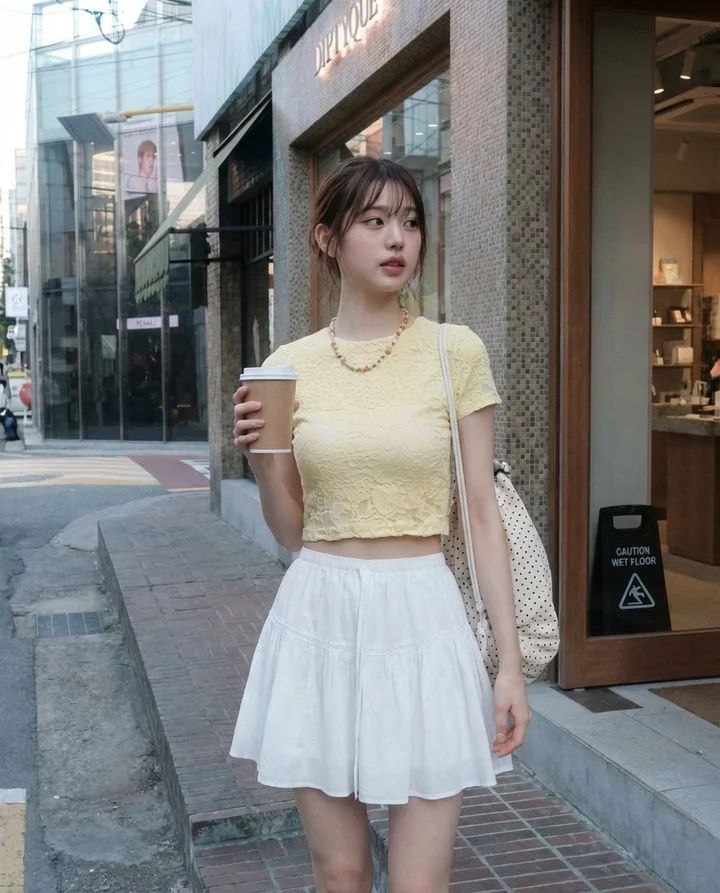
Korean fashion photography has something else that generic product shots don't: a sense of place. The streets of Seochon, the luxury strip of Cheongdam, the Mardi Mercredi bench in Seongsu - K-fashion buyers recognize these locations from years of influencer content and brand lookbooks. When a product photo places a model there, it carries the credibility of that whole cultural context.


A model standing in front of the Dior building on Cheongdam is saying something about the brand. A model at the London Bagel Museum in Seochon is saying something different - more lived-in, more editorial. Both are recognizable to buyers who follow Korean fashion. Both carry associations that a white-background product shot simply can't.


StyleRoom's hotplace feature lets you choose the Seoul neighborhood your model appears in - Apgujeong, Cheongdam, Seochon, Seongsu, Euljiro, and more. Each one carries different associations. Each one is a tag selection.
05 - What actually solves it AI trained on the right data
StyleRoom was built on imagery from Korean fashion platforms - Musinsa, Ably, the visual language that defines how Korean fashion actually gets photographed and sold. When you upload a product photo, the AI generating your model shot has been trained on that specific visual culture. Not a generic approximation of it.
You get Korean model photography that reads as Korean - the posture, the expression, the color temperature - placed in a Seoul neighborhood that matches your brand's positioning. For a brand selling K-fashion to international buyers, that combination is the closest thing to a Seoul shoot that doesn't require a flight to Seoul.
06 - Who this is for If any of these describe you, read this twice
-
-
Brands selling K-fashion, J-fashion, or C-fashion internationally Your buyer has a specific visual expectation shaped by the culture your product comes from. Your photos need to match it.
-
-
Asian-American or diaspora-focused brands Buyers in these communities notice representation immediately. It signals that the brand was made with them in mind.
-
-
International brands entering the Korean market If you're trying to position on Korean platforms like Musinsa or Ably, your product images need to meet the visual standards Korean buyers expect.
-
-
Any seller whose buyers are K-fashion influenced This is a larger audience than it sounds. K-pop and K-drama have built a global buyer base that recognizes Korean fashion aesthetics - and responds to them.
Korean model photography, trained on Korean fashion - from anywhere
Upload a product photo. Choose a Korean model and a Seoul neighborhood. Get images that carry the visual credibility of a brand that's actually from Seoul - without the trip, the agency, or the budget.
Try StyleRoom
See your products on a Korean model, in Seoul.